
What Stafford County Property Tax Records Show
A Stafford County tax account is more than a dollar figure. It carries a tax year and a classification. It also holds appraised and assessed values, a levy, and a payment status. The Appraiser handles valuation and appeals. The Treasurer bills and collects. The County Clerk keeps the tax roll and levy records. Treat a taxpayer name as a lead toward the account, never as proof of title.
| Field | What It Shows | Where |
|---|---|---|
| Appraised value | County estimate before the class rate | Appraiser |
| Assessed value | Taxable value after classification | Appraiser |
| Account and year | Tax type, year, and CAMA key | Treasurer search |
| Tax due/status | Current or delinquent account information | Treasurer |
| Levy | Rates from applicable taxing units | County Clerk |
Kansas derives assessed value by multiplying appraised value by a classification rate. It is not a sale price. Farmland is valued by agricultural use, not by what the land would fetch on the open market.
Stafford Treasurer Search Fields
The Stafford Treasurer tax search covers real estate, personal property, oil and gas, truck, mineral, and utility accounts. Fields include owner or taxpayer name, CAMA number segments, street address pieces, ZIP, legal description, year, and current or delinquent status. A database-updated label also appears on the screen. That stamp belongs to the whole database. The official tax lookup shows every one of these search choices together.
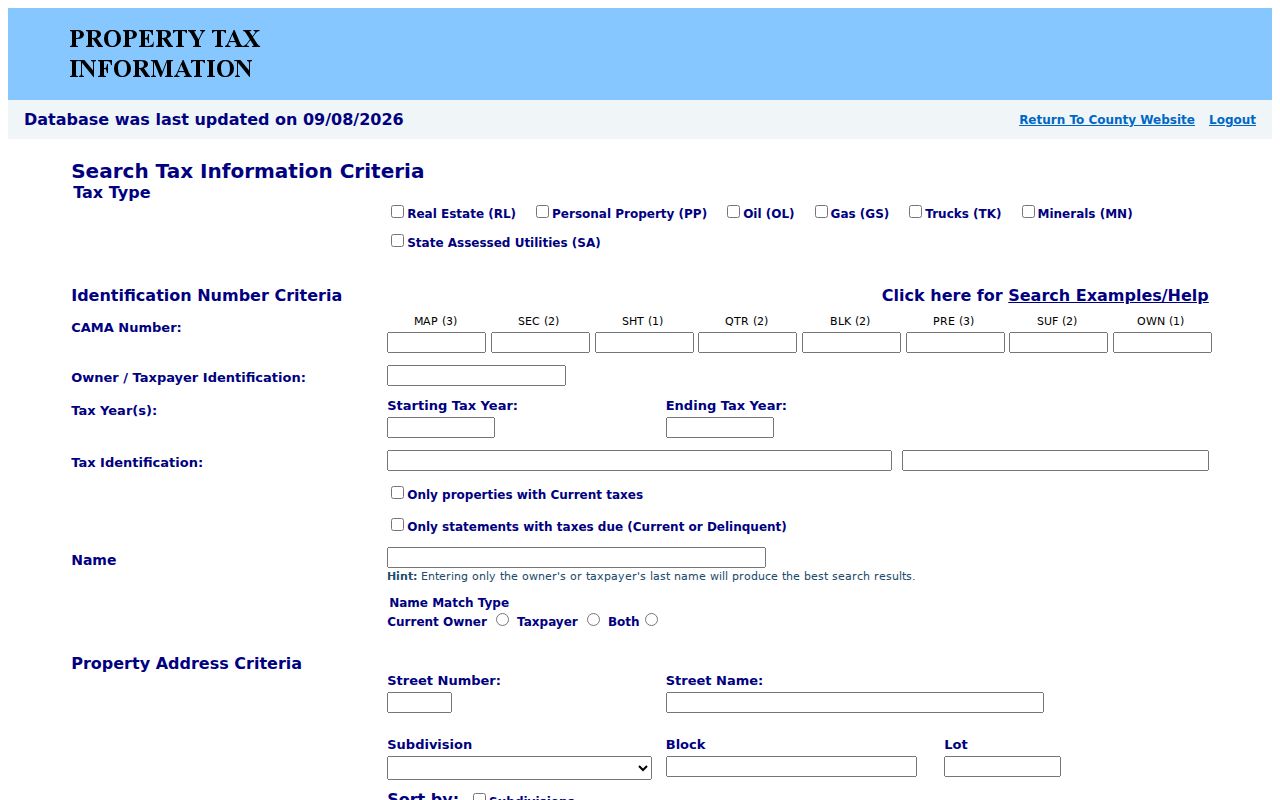
Account type and year belong beside every name result. The updated label reflects the database as a whole, not each owner or value on its own. When you save a record, note the year and the date you checked it.
Stafford Tax Types Differ
Not every account is ordinary residential real estate. Stafford County also bills oil, gas, mineral, truck, and utility interests. A party can hold a taxable interest without owning the surface parcel. So select the tax type before trusting a name match. Mineral leases and royalty transfers can also appear among Register of Deeds instruments. Link the account to the correct legal description. Only then should you draw a conclusion.
Looking Up a Stafford County Tax Bill
Start with the address when you know the site. Owner or taxpayer works better for finding a party, while CAMA and legal-description fields shine once another official record supplies them.
- Choose the correct tax type and year in the Treasurer search.
- Enter the street, name, CAMA key, or legal description with as few limits as needed.
- Read the account, tax status, taxpayer and year together.
- Contact the Appraiser for the supporting valuation card and the Treasurer for payment questions.
- Assessed value
- The taxable value after the classification rate is applied.
- Mill levy
- A rate used with assessed value to calculate tax.
- Taxpayer
- The person or entity tied to the tax account, which may differ from the title owner.
- Tax lien
- A legal claim arising from unpaid tax.
Stafford Delinquent Tax Records
The county's 2024 real-estate publication list names owners. It also lists map or CAMA identifiers, legal descriptions, and amounts. It can point you to a tax account or an addition name. It is a dated list. It proves nothing about today's balance. Confirm current status with Treasurer staff. Use published additions to help locate the right deed or plat.
Stafford Appraised Versus Assessed
The Kansas Department of Revenue value guide gives the core formula: appraised value times the assessment rate equals assessed value. Class rates and the farm-use rules sit in the classification guide. The Stafford Appraiser page lists the local office and its calendar.

Treat the Appraiser page as an office and appeal resource. It offers no public parcel-card search. A 2026 Market Study Analysis label appears there. But a label alone says little about any one parcel's trend. Ask the office for the property card and the study material itself.
Paying Stafford Property Tax
The Kansas property-tax payment portal asks for your county plus statement or account details. Card and electronic-check options may apply. Convenience fees vary, so check them at payment time. Paying online does not replace a review of the county account itself. For balances and posting questions, the Stafford County Treasurer is the direct source. Save your receipt and the account year.
Stafford Taxpayer Versus Owner
The name on a Stafford County tax account may be marked owner, taxpayer, or both. The label matters. Someone often pays for an estate, a trust, or another party. A recently recorded deed may not have reached the tax roll yet. So use the tax name to find the account. Treat it as a lead, not title proof.
Next, compare the account against the parcel's legal description and CAMA key. Then confirm the current grantee in the Register of Deeds. The county's public GIS layer can supply another name and a mailing address. That parcel layer, though, carries a 2019 edit date. An old snapshot helps with cross-reference. It cannot tell you who owns the land today.
Mailing and situs addresses differ too. The situs locates the property; the mailing field routes correspondence. A rural Stafford County parcel can carry one road address as its situs. It can also carry a second for owner mail. Neither address shows whether the land sits inside city limits. Use the GIS MunicipalBoundary layer or municipal records to settle jurisdiction.
Stafford Levies and Tax Units
A Stafford County tax bill sums more than one levy. School districts, the city, the county, and other taxing units all add their share. The County Clerk keeps the levy and taxing-unit records. GIS adds TaxUnits and MunicipalBoundary layers for mapping that geography. Before comparing two bills, read the levy sheet. Then check each parcel's taxing units.
A bigger bill does not always mean the appraised value moved. Classification changes the assessment rate applied to value. Assessed value, exemptions, relief, delinquency, and account timing all shape the final figure. Compare like years and like property classes. Keep penalties and prior balances apart from the base current-year calculation.
The tax search includes current and delinquent filters plus a statements-with-taxes-due option. Those controls settle account questions. They reveal nothing about appraisal method, though. Value and classification belong to the Appraiser. The Clerk answers levy questions. Billing, due status, and payment posting sit with the Treasurer.
Stafford Tax Record Requests
Sometimes the public search will not answer the question. Then request the record from its custodian. Include the parcel or CAMA key, the situs, the legal description, the tax year, and the exact document wanted. The Appraiser holds parcel cards, classification, value notices, and appeal records. The Treasurer handles statements, payment history, and delinquency. Levy and tax-roll material belongs to the County Clerk.
KORA governs these requests, subject to its exemptions. Kansas guidance allows agencies to charge reasonable actual costs, including staff or redaction time. Advance payment may be required. The agency must respond as soon as possible and no later than the third business day, or explain the delay. A response date is not always a production date.
Ask for a cost estimate when a request spans many years or needs archive retrieval. State the format you want. Say whether inspection alone would satisfy the need. Keep the reply with its tax year, because a later portal result may show a different status after payment or correction.
Stafford Tax Classes and Relief
Read Kansas property tax records with the property class in hand. State guidance sets assessed value at appraised value multiplied by the assessment rate. Residential real property carries an 11.5 percent rate. Commercial and industrial real property uses 25 percent. Agricultural land is assessed at 30 percent of agricultural-use value. That figure differs from an open-market estimate. A parcel with several classifications may need more than one line on the appraisal record. Only then does the assessed total make sense.
Relief and exemptions can change the taxable result without touching the deed. The Stafford County Clerk lists homestead and Food Sales Tax refund work among its duties. The Appraiser handles classification, valuation notices, and local appeal steps. Eligibility depends on the current Kansas program and the claimant's facts. Ask the responsible office for the form, filing period, and required proof. Never infer eligibility from a lower tax amount. The Treasurer can explain what was billed or paid. But that answer does not replace the office that set the value or the relief.
Three records belong together when checking a Stafford County tax figure. Pull the Appraiser's card for class and value. Pull the Clerk's levy or taxing-unit material. Pull the Treasurer's account for the bill and payment status. Match the tax year on all three. Mixing years can make a valid change in value or levy look like an error. GIS TaxUnits and MunicipalBoundary layers help identify the taxing geography. The mapped boundary stays a reference, so confirm it whenever jurisdiction is disputed.
Appealing a Stafford County Assessment
The Stafford County Appraiser lays out two routes. After a value notice, an owner generally has 30 days to request an informal meeting. A payment-under-protest route is also available once taxes are paid. Dates depend on the notice and the procedure. Rely on the county's current notice and appeal document.
Appeal window. Stafford County states a 30-day period after mailing of the value notice for an informal appeal. Read the notice and contact the Appraiser at once.
Bring facts tied to the valuation date. That means an accurate property description, condition evidence, and relevant sales. An appraisal challenge addresses value only, not the mill levy itself.