
Stafford County Deed Records and What They Show
Every instrument filed with the Stafford County Register of Deeds captures who signed. It also shows what land changed hands, and when. Mortgages, releases, mineral deeds, leases, liens, plats, and affidavits round out the record. Recording puts the world on notice. Acceptance by the office, though, never certifies that the transferor held perfect title.
| Deed Type | What It Does | Common Use |
|---|---|---|
| Warranty deed | Conveys title with stated covenants | Ordinary purchase |
| Quitclaim deed | Conveys whatever interest the grantor holds | Family or title cleanup |
| Mineral deed | Transfers a mineral interest | Oil, gas, or royalty ownership |
| Trustee or executor deed | Transfers through a fiduciary | Trust or estate administration |
| Tax deed | Documents a tax-sale transfer | Delinquent-tax proceeding |
Burden and transfer are different things. A mortgage or lien only encumbers the land, so pull the matching release or assignment before treating an old encumbrance as still active.
Stafford Deeds Through CIC
Stafford deeds sit behind a subscriber gate. The CIC RMIS eSearch requires credentials plus a six-digit verification challenge. County guidance allows one-day or one-month access. Remote printing runs on a separate annual plan. Because the public login hides the live document fields, searchers should check the menus after signing in rather than guessing at them.
Online name indexes reportedly cover 1973–1983 and 1998 forward, though one county sentence ends the first span at 1982. Images are said to reach back to 1879, but searchers should confirm the exact cutoff with the office.
The official Stafford login displays the access gate.
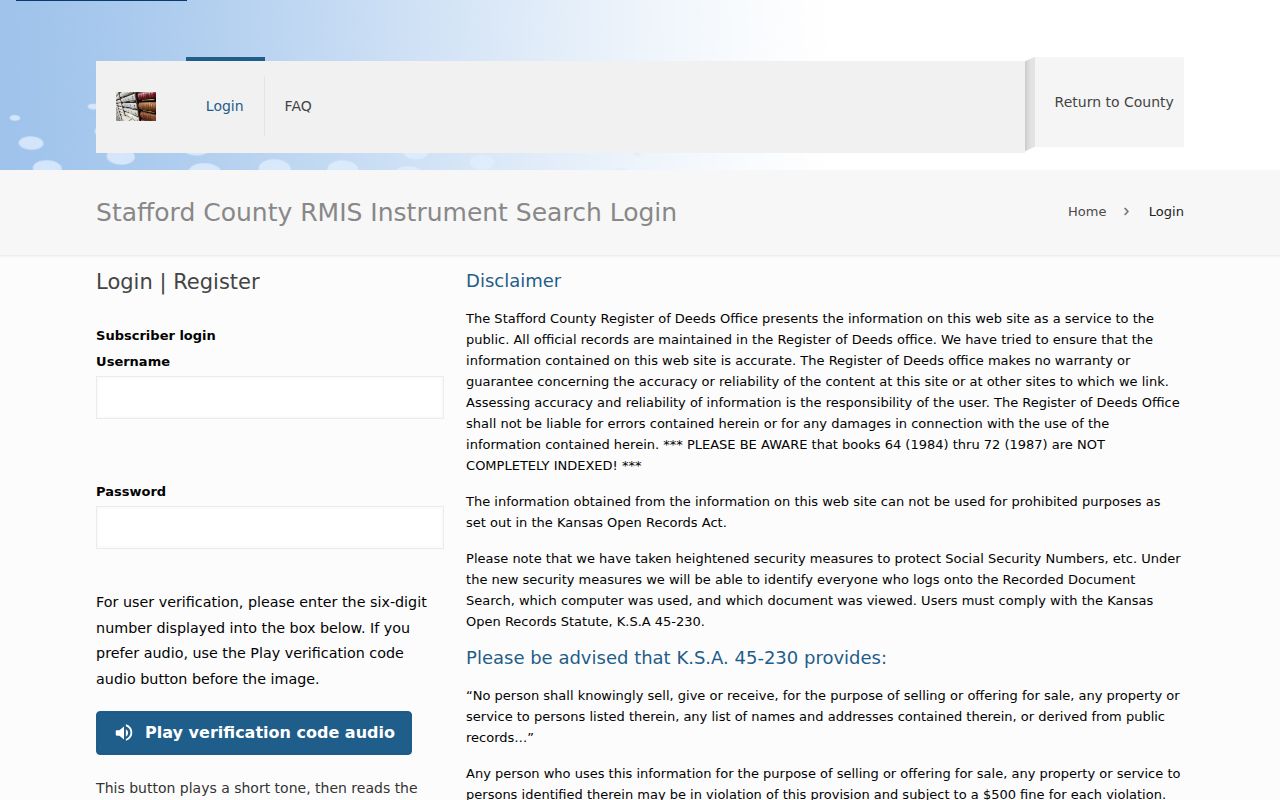
Subscriber and verification controls hide the full index form.
Stafford Books 64 Through 72
Books 64 through 72 carry instruments dated 1984–1987. The county flags them as incompletely indexed. That gap matters in practice. A blank name search proves nothing for those years. Save the party name, legal description, and approximate transfer date. Then ask the office to run a book search. Scanning continues, and a missing image may still survive on paper or film.
The Stafford County Grantor-Grantee Index
The grantor transfers an interest. The grantee receives it. Linked together for a single legal description, those transfers form the chain of title, so start with the most recent reliable deed and walk backward.
- Find the current owner’s purchase deed with that owner shown as grantee.
- Read the grantor, legal description, date and book/page or instrument reference.
- Search that grantor as an earlier grantee and repeat the match.
- For online gaps, move to office books, images or archival microfilm.
- Grantor
- The party transferring an interest.
- Grantee
- The party receiving that interest.
- Chain of title
- The ordered transfer history for the same land.
- Book/page
- A volume and page citation used to retrieve an older instrument.
Older Stafford Deed Books
The Kansas Historical Society Stafford collection spans 1879–1982 and holds county journals, dockets, probate material, and microfilm leads. The county microfilm program explains archive access. These sources feed historical research. Context helps, but tie every finding back to the legal description and the Register of Deeds record.
The county office page starts the local deed-book search.
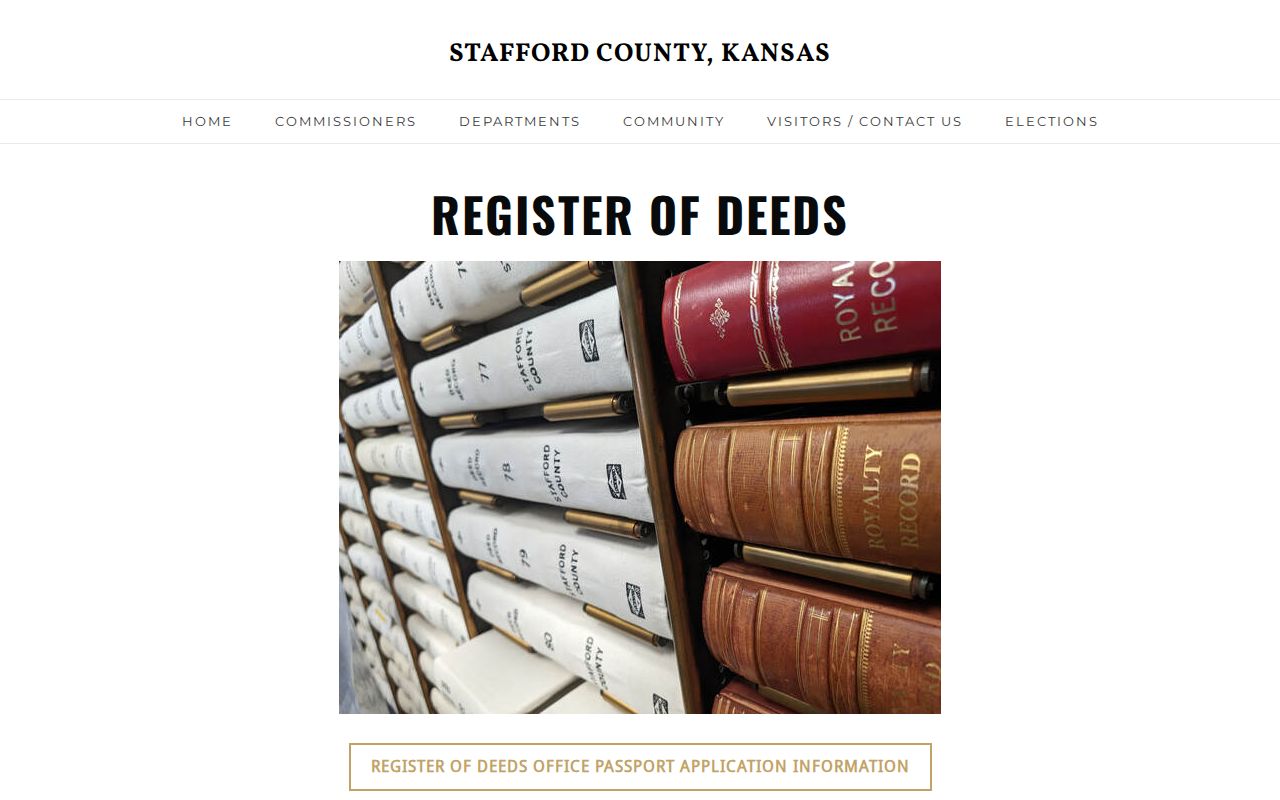
Coverage notes matter when a search returns nothing. St. John's 1879 county-seat history and Macksville's 1885 town-company record can explain early plats and additions. Treat both as context, never as substitute conveyances.
Stafford Recording Notifications
Stafford County's recording notification form enrolls name variants and contact details so an alert can go out when a document is recorded. The form says plainly that it is not a fraud-prevention tool. An alert cannot stop a filing. It cannot prove fraud or establish title either. Use any notice as a prompt to pull the instrument and call the office. Confirm submission and renewal details with the Register.
Stafford Deed Recording Rules
Recording in Stafford County generally calls for an original signed instrument, proper notarization, a county legal description, and the correct fee. A plain photocopy will not do. Only certification as an original makes a copy recordable. Deeds and affidavits of equitable interest carry an added requirement: a Kansas Real Estate Sales Validation Questionnaire or a typed statutory exemption on the deed itself. That questionnaire gathers buyer and seller details, situs and tax addresses, legal description, use, financing, special factors, total sale price, deed date, and certification.
The form is closed by statute, with limited exceptions. The data still aids valuation. Even so, its fields help the state and county administer what a searcher will never see in the public deed image.
Recording fees and copy fees are separate. The county points filers to K.S.A. 28-115 for recording charges. The right amount depends on the instrument and current law. Verify before filing. A rejected submission delays public notice, so format and legal-description checks belong ahead of delivery.
Stafford Deeds and Encumbrances
Stafford County's land books hold far more than simple ownership deeds. The document inventory spans mortgages with their assignments and releases, oil and gas leases, mineral deeds, and royalty sales. It also covers federal and state tax liens, mechanic liens, affidavits, powers of attorney, plats, and some UCC Article 9 filings. Each category records something different. Read it accordingly.
A mortgage proves a secured interest. Its release shows satisfaction. An assignment can shift the lender's stake while the landowner stays the same. A mineral deed can carve subsurface rights away from the surface estate. Tax liens and mechanic liens demand extra care. You must trace later releases, judgments, or other terminating papers. Search both party names and the parcel's legal description. Then follow every related reference in both directions.
Court files add context. Foreclosure, quiet title, partition, probate, or lien enforcement can sit behind a deed. The Kansas District Court portal covers current matters. The Stafford clerk can supply older or fuller material on request. Afterward, confirm that any deed, release, or other operative instrument actually reached the Register of Deeds.
Stafford Plat and Addition Clues
A town parcel is usually described by lot, block, and addition. A street address is not the usual form. Official delinquent-tax and sheriff-sale notices preserve addition names in St. John, Stafford, and Macksville. They work well as discovery tools when no countywide subdivision list exists. Still, a notice is never the controlling plat.
Copy the addition name exactly as written. Then ask the Register of Deeds for the original plat book and page. Also request the dedication, any later replat or vacation, and the lot map. Match the lot and block from the deed against that record. Rural land works differently. Use section-township-range plus acreage clues. Remember that mapped acreage is not a surveyed measurement.
Local history can explain how an addition began. Macksville's 1885 Town Company packet holds a filing and a layout purpose. It also includes an incorporation petition and metes-and-bounds language. St. John's town-company and county-seat story points toward early records geography. Those accounts guide name and date searches. The recorded deed and plat supply the legal trail.
Stafford Deed Copy Costs
Stafford County lists several copy and access charges, and keeping them straight saves money. A hard copy runs $0.50. Fax service costs $1 per page. It adds $0.50 per page if the office must print the record first. An emailed patent-to-present request, when offered, is $1 for the first page. Each later page costs $0.25. Index pages run $5 each, and camera use costs $50 per day with approval. Before approving any charge, ask what the product is. Is it a plain copy, an index page, or a certified record?
CIC RMIS access follows a separate schedule. Annual remote access is listed at $350 plus $0.25 per page. One month runs $75 plus $0.25 per copy, and one day is $25 plus $0.25 per copy. Card payments add 2.9 percent plus $0.30. The CIC FAQ explains registration, county selection, subscriptions, and page purchases. None of these amounts sets the fee for recording a new deed; Stafford County points filers to K.S.A. 28-115 for recording charges, which should be verified when the instrument is presented.
An efficient order starts with a precise citation. Give the deed records office the grantor, grantee, and approximate date. Include the legal description and any known book/page or instrument number. If an online image is missing, ask a question. Is the page still being scanned, or must it be pulled from an older book? For a chain crossing the incomplete 1984 through 1987 window, skip broad runs of index pages. Request a targeted book search instead. A gap in the index is not proof the instrument never existed.
Getting a Copy of a Stafford County Deed
Request Stafford County deed records from the Register of Deeds, 209 N Broadway, second floor, St. John, Kansas 67576, (620) 549-3505. Office hours are 8 a.m. to 5 p.m. weekdays. Provide party names, the legal description, an approximate year, and any book/page or instrument clue. Online users can buy pages through CIC. Older books may need phone, email, counter, or mail handling. Confirm current copy and certification charges before ordering.
Recorded, not guaranteed. Stafford County deed records show accepted instruments, not a title opinion. Unrecorded interests and unresolved defects may exist.
Original instruments submitted for recording generally need signatures, notarization, a Stafford County legal description, and the correct fee. Deeds and equitable-interest affidavits also require the Kansas sales validation questionnaire or a typed statutory exemption.